.png)
Canadian amateur twist champion mastered lascivious hip swivel navigating Linby Street garage bicycle, tool chest, garbage bin bedlam
Updated: Oct 26, 2024

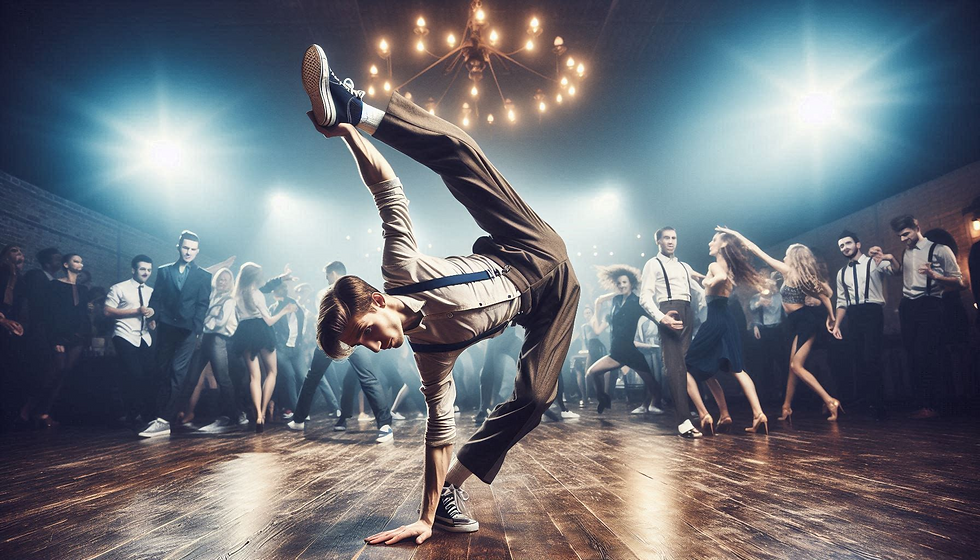
Canada’s reigning amateur twist champion, Alex "Twistmaster" O'Leary, didn't just learn to dance in the traditional sense. His mastery of the lascivious hip swivel was honed through years of navigating the chaotic confines of his family’s Linby garage. Filled to the brim with old bicycles, a towering tool chest, and a labyrinth of garbage bins, the garage became an unlikely training ground.
Each day, O'Leary would practice his twist routines amidst the clutter, perfecting his movements in a space where every turn was a challenge. The obstacles that once frustrated him became the very elements that sharpened his skills. With each hip swivel, O'Leary learned to adapt, turning tight corners and maneuvering around junk, transforming his home’s chaotic garage into a dance floor.
This unconventional practice space forged a champion whose finesse and fluidity set him apart. O'Leary's years of navigating the junk-filled garage have not only refined his technique but have also made him a master of the twist, proving that sometimes the best training grounds are the most unexpected.
FURTHERMOREOVERKILL
G Papa Tango, please rank, in from most technically difficult to least, the various kinds of dance around the world.
Ranking the technical difficulty of dance styles can be subjective, as it depends on various factors, including the physical demands, the complexity of movements, coordination, and the level of training required. However, based on general consensus and the technical demands of each style, here’s a broad ranking from most to least technically difficult:
1. Ballet
Technical Demands: Extreme precision, balance, strength, and flexibility. Requires mastery of pointe work, complex choreography, and consistent alignment.
Training: Often begins in early childhood with years of rigorous practice.
2. Classical Indian Dance (e.g., Bharatanatyam, Kathak)
Technical Demands: Intricate footwork, hand gestures (mudras), and facial expressions. Requires a deep understanding of rhythm and storytelling.
Training: Years of study to perfect the techniques, usually under the guidance of a guru.
3. Breakdancing (B-boying/B-girling)
Technical Demands: Requires strength, agility, and coordination. Involves power moves, freezes, and acrobatic elements like flips and spins.
Training: Often self-taught, but the level of athleticism required is extremely high.
4. Contemporary/Modern Dance
Technical Demands: A blend of ballet and modern techniques with an emphasis on expression, floor work, and often unconventional movements.
Training: Requires versatility and a strong foundation in ballet, but with more freedom for personal interpretation.
5. Flamenco
Technical Demands: Complex footwork, hand clapping (palmas), and body movements combined with emotional expression.
Training: Involves mastering intricate rhythms and coordination between movements and music.
6. Ballroom Dance (e.g., Latin dances like Samba, Paso Doble)
Technical Demands: Requires strong posture, precise footwork, and coordination with a partner. Dances like the Paso Doble are particularly demanding.
Training: Typically requires formal instruction and years of practice, especially at competitive levels.
7. Argentine Tango
Technical Demands: Requires smooth, controlled movements, intricate footwork, and close connection with a partner.
Training: Involves mastering the nuances of leading and following, with an emphasis on improvisation.
8. Irish Dance
Technical Demands: Rapid, precise footwork while maintaining a rigid upper body. Requires stamina and agility.
Training: Involves extensive practice to achieve speed and accuracy.
9. Tap Dance
Technical Demands: Coordination between footwork and rhythm, often at a fast pace. Involves intricate foot patterns.
Training: Requires both musicality and technical footwork.
10. Hip Hop
Technical Demands: Involves a range of styles, from popping and locking to krumping and house, each with its own set of complex movements.
Training: Often learned informally, but high-level dancers train rigorously to perfect their technique.
11. Jazz Dance
Technical Demands: Combines ballet technique with sharp, rhythmic movements. Emphasizes flexibility, strength, and coordination.
Training: Usually requires formal dance training, with a focus on both technique and performance.
12. Capoeira
Technical Demands: A martial art blended with dance, involving acrobatics, kicks, and fluid movements. Requires strength and agility.
Training: Involves mastering both the martial art aspects and the dance-like flow.
13. Salsa
Technical Demands: Requires coordination with a partner, quick footwork, and fluid body movements.
Training: Can be learned relatively quickly, but mastering the style requires practice.
14. Folk Dances (e.g., Cossack, Hula, African tribal dances)
Technical Demands: Varies widely by region. Some, like Cossack dancing, require incredible leg strength, while others focus more on rhythmic and communal movements.
Training: Often passed down through generations, some are simple while others are complex.
15. Line Dancing
Technical Demands: Involves synchronized steps and patterns, often repeated in sequence.
Training: Relatively simple to learn, but mastering the timing and style can take practice.

This ranking is general and doesn't account for the specific challenges that individual dancers may face depending on their background, body type, and previous training.


Comments